
Bil'in, a Palestinian village, will lose a good part of its land after the erection of the separation barrier by the State of Israel. Plans for expropriation have been met by hefty protest: among the antibarrier activists was Shai Carmeli Pollak, who videorecorded the spontaneous protest action. The film exposes the extraordinary relationship between the villagers and a group of Israeli activists. The conflict that arises between Shai and the soldiers serving in the area is not only between a director and the subjects that he is documenting, but also the conflict between a former soldier, turned peace activist, and the entire military organization.
Bil'in habibti
International Title
Bilin My Love
Genre
Documentary
Country
Israel
Year
2006
Duration
84'
Claudia Levin
Production Companies
Claudius Film
Languages
Arab, Hebrew
Director's Notes
Director's Notes
«I did not come to Bil'in as a filmmaker, but as an activist, to take part in the protest against the land theft caused by the separation barrier. For a year and a half, I used my camera to document the moments of despair and hope, danger and courage and the birth of true partnership between Palestinians and Israelis. During this period the village became a symbol of the joint struggle against the barrier and the occupation».
In-depth analysis
About the Movie Bilin My Love
The global human rights landscape presents a worrying picture of widespread violations, forgotten wars, and unresolved humanitarian crises, with tens of thousands of victims and refugees.
Within this bleak picture, this section of the 2007 CinemAmbiente festival focused on two particularly timely and serious issues. On the one hand, the "war on terror," which better than any other phenomenon symbolizes the ongoing globalization of human rights violations; on the other, the 40-year occupation of the Palestinian Territories.
After September 11, 2001, the goal of ensuring security against terrorism led many countries to introduce restrictive measures that allow new forms of curtailment of fundamental freedoms. Unfortunately, however, today the world is not only no longer safe, but the systems for protecting and safeguarding human rights have also been progressively dismantled.
Similarly, the conflict in Iraq, which aimed to neutralize a dictatorship and "bring democracy," has led to death, violence, and instability in the country.
News come from Iraq every day, but few know what's really happening in that country occupied by foreign forces and ravaged by internal conflict, beyond the daily images of horror we see on television. "My Country My Country" analyzes Iraq during the first post-Saddam elections through the eyes of a Sunni doctor, exploring glimpses of daily life and attempts to rebuild civil society.
If this section of the festival seeks to highlight the contradictions and cruelties unleashed by the "war on terror" policy, it couldn't miss one of the places that has become its emblem: Guantanamo. "Gitmo" begins with a visit by the filmmakers to the detention center, organized by the US military itself. Their documentary stems from the case of a young Swedish citizen of Algerian origin, arrested in Afghanistan and subsequently transferred to Guantanamo, where approximately 400 people of 35 different nationalities are still being held today.
An additional 10,000 are believed to remain in US custody in prisons and detention camps in the United States, Iraq, and Afghanistan. An unknown number of people are believed to be held in secret detention centers. They are the victims of the CIA's "extraordinary rendition" program, under which the US and other governments—including European countries, including Italy—illegally arrested thousands of people, transferring many of them on secret flights to third countries, where they faced further human rights violations, including torture. This illegal practice remained almost completely shrouded in secrecy until 2006, when it was exposed in an Amnesty International report. “Outlawed,” produced by Witness, an American organization that uses video as its primary tool for human rights advocacy, recounts the cases of two people who survived the experience of “extraordinary renditions.”
Among the disturbing examples of how growing national security fears have reduced the space for tolerance and dissent, and how someone can be imprisoned for years without substantiated charges simply because of their beliefs, is the case chronicled by Norwegian director Line Halvorsen in “USA vs. Al-Arian.” Sami Al-Arian, a Palestinian who has lived in the United States for years and is a university professor and activist for the Palestinian cause, is accused of being an Islamic terrorist and has been imprisoned for over four years without a guilty plea. Alia Arasoughly, director and organizer of the Shashat Women's Festival, is also Palestinian. In a recent interview, she stated: "In Palestine, there is no peace, there is no freedom. It's like being in prison: living in Palestine means having a small life, smaller every day."
Israel has occupied the Palestinian territories of the West Bank, the Gaza Strip, and East Jerusalem since June 5, 1967. Four decades of military presence have had a severe impact on the daily lives of millions of Palestinians. The incessant expansion of Israeli settlements on occupied lands deprives the Palestinian population of crucial resources and forces them to implement a series of measures that confine Palestinians to fragmented enclaves, hindering their access to employment and health and education services.
The construction of a 700-kilometer security barrier, largely within the West Bank and through the expropriation of Palestinian lands, in defiance of the International Court of Justice, is separating Palestinian towns and villages in the West Bank and depriving farmers of their land and agriculture. Palestinian movement is also severely limited by other restrictions.
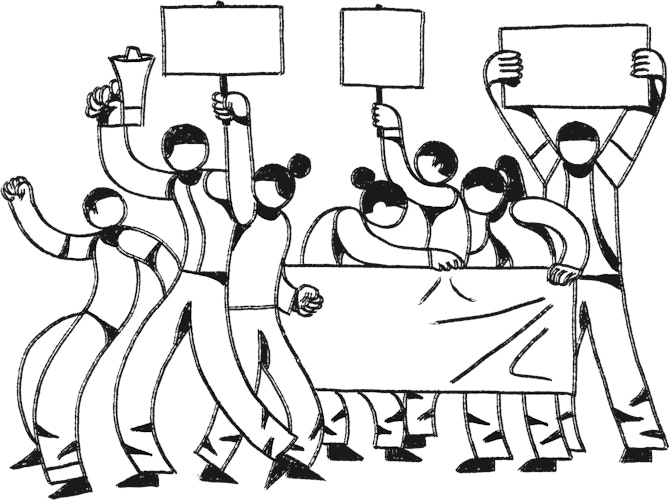
Activism
Activism
Whether in a small setting or a large one, whether in one's own city or on global stages, whether working alone or as part of large movements, those who have rallied together in recent years to protect the planet have shown strong commitment.
Food on Film project
Partners





With the contribution
Funded by the European Union. Views and opinions expressed are however those of the author(s) only and do not necessarily reflect those of the European Union or the Creative Europe Media Program. Neither the European Union nor the granting authority can be held responsible for them.